TSAKANE, South Africa (AP) — Gladys Khoza had missed being able to see her family. Not because they couldn't visit, but because the 84-year-old had vision problems.
Now that has changed. Khoza is one of 133 people whose sight was restored during a “marathon” of free cataract surgeries conducted by doctors in South Africa at two hospitals over two weekends last month.
“Wow!” a delighted Khoza whispered as a nurse peeled back a bandage a day after her operation, and the world came back into view.
“Can you see me?” the nurse asked. “Very well,” Khoza replied, a big grin on her face.
Patients in South Africa's public health service can be on waiting lists for years for the simple 15-20-minute cataract operation. Officials said some of those who were selected from hospital waiting lists for the surgeries had been waiting since 2019 to see properly again.
Cataracts are a common, often age-related condition in which the eye's lens becomes clouded, and they are the leading cause of curable blindness. The surgeries insert a new artificial lens.
For Khoza, who said she couldn't see anything out of one eye because of a cataract and had long had issues with the other, the simple surgery equates to a major boost for her quality of life.
“I just wanted to be able to see,” she said. Now, after nearly a year of waiting, some of her favorite things — seeing loved ones, reading her Bible and watching late-night soap operas — are all possible again.
Dr. Tebogo Fakude, one of the doctors who volunteered to perform the operations at two regional hospitals near Johannesburg, said his mother was blind and that having sight restored is “beautiful.”
"It's beautiful because it alleviates depression,” Fakude said adding that the sense of being a burden was also eased.
Globally, more than 2 billion people suffer from some kind of vision impairment, according to the World Health Organization. For half of them, the problem could have been prevented, or they are still waiting for treatment.
Nearly 100 million people are affected by cataracts, and half of them still need access to surgery, according to the WHO. In Africa, that figure rises to 75% of people without surgery, according to a study published in March by the Lancet medical journal.
Surgery backlogs are a significant problem in South Africa, where government-run hospitals serve more than three-quarters of the population of 62 million people. Limited resources mean emergency procedures and more serious operations are prioritized over elective surgery.
The Health Department-led surgical marathons were first staged on Mandela Day in 2023 to commemorate the legacy of the country’s first Black president, Nelson Mandela. They have developed into a public-private partnership that takes place several times a year to increase access to care.
The ministry has vowed to use surgical marathons as a means of eliminating backlogs. Previous ones have addressed prostate, cleft palate and stomach issues.
Cataracts became the latest focus. Around 300,000 new cases are diagnosed every year in South Africa, Fakude said.
Health groups say South Africa faces a backlog of over 240,000 people waiting for cataract operations. Over 35,000 people in the most populous province of Gauteng — where the surgery marathon was performed — have cataract-related blindness.
WHO says eye cataract operations are “one of the most cost-effective medical procedures,” and a powerful tool to restore someone's independence, dignity and opportunities.
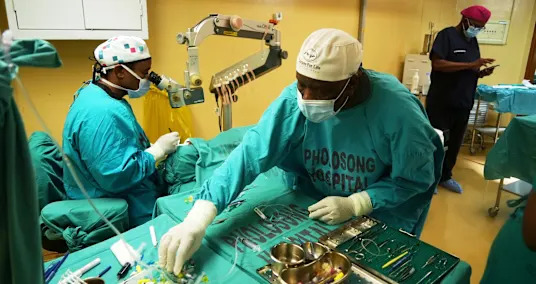
During the three-day surgery marathon at Pholosong Regional Hospital, a new patient was brought into the operating theater about every 30 minutes. Soothing gospel music played on speakers to keep up doctors' morale.
Looking through a microscope, the eye specialists made tiny incisions for each operation, removed the cloudy lens and replaced it with an artificial one. At one point, two surgeons worked concurrently on separate patients to quicken the pace. They completed 60 surgeries on the last weekend of the marathon.
Molefe Mokoena, 72, said he was looking forward to regaining his independence after suffering from a cataract for four years.
"I want to see my great-grandchildren,” he said. “I want to drive my car, and I'm happy about this.”
___
For more on Africa and development: https://apnews.com/hub/africa-pulse
The Associated Press receives financial support for global health and development coverage in Africa from the Gates Foundation. The AP is solely responsible for all content. Find AP’s standards for working with philanthropies, a list of supporters and funded coverage areas at AP.org.
latest_posts
- 1
 10 Natural products to Remember for Your Eating routine for a Better You
 - 2What's the new 'Knives Out' mystery about? Everything to know about 'Wake Up Dead Man,' including who's in the cast and what the reviews say.
- 3A Colombian city swaps iconic horse buggies for electric carriages amid animal welfare concerns
- 4How a niche Catholic approach to infertility treatment became a new talking point for MAHA conservatives
- 5The Magnificence of Extraordinariness: Presenting Valuable Adornments and Gemstones


- ‘Risk children’s lives for some extra manpower’: IRGC recruits 12 year olds to fill personnel gaps
- From White Elephant to Favorite Things parties, here are all the rules you need to know every kind of gift exchange
- The newest 'Project Hail Mary' trailer shows Ryan Gosling befriending an alien in Phil Lord and Chris Miller's space epic
- Russian strikes on Ukraine kill 5 people and wound 30 more
- BioMarin to acquire Amicus Therapeutics for $4.8 billion in rare disease bet
- Chief of Staff Zamir warns IDF will collapse due to lack of manpower, raises 'ten red flags'
- Climate engineering would alter the oceans, reshaping marine life – our new study examines each method’s risks
- A somber Thor is returning for 'Avengers: Doomsday': Watch the dread-filled teaser
- Culinary Joys: Investigating Connoisseur Cooking at Home