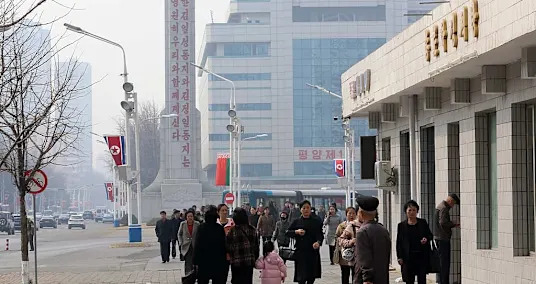
China has announced that its flag carrier, Air China, will resume direct flights to North Korea after a six-year pause, following the restoration of passenger train services between Beijing and Pyongyang.
This marks a significant step toward reopening North Korea, one of the world's most isolated nations, to the world.
Transport links between the two capitals had been suspended since the start of the Covid-19 pandemic in 2020, when Pyongyang implemented a very strict border closure.
While North Korean carrier Air Koryo already resumed flights to Beijing in 2023 and allowed Russian tour groups to visit in 2024, the return of China's air and railways are seen as a major economic milestone, as China has for decades been the main trading partner and a key source of diplomatic and economic backing for the country of 26 million people.
Before the pandemic, there were an estimated 300,000 foreign visitors in 2019, according to South Korea's Institute for International Economic Policy, and Chinese visitors accounted for 90% of all tourists to North Korea. Therefore, the long delay in resuming regular travel had surprised many regional observers.
"The reopening of these borders has been driven primarily by Pyongyang's timeline, which challenges the outdated assumption that Beijing dictates terms to a dependent client state," Seong-Hyon Lee, a visiting scholar at the Harvard University Asia Centre, explains.
Related
Nuclear ambitions complicated the relationship
Despite being Pyongyang’s primary ally, Beijing has frequently voiced disapproval over the North's persistent missile tests and nuclear ambitions. This aspect created a bumpy relationship with Pyongyang, with analysts saying that a nuclear-armed North Korea has often been something of a liability.
The diplomatic normalisation was highlighted last September, when Kim Jong Un attended a massive military parade in Beijing alongside Russian President Vladimir Putin. This was Kim's first appearance at a Chinese military display.
Lim Eul-chul, a North Korea expert at South Korea's Kyungnam University, argues that the war in Iran, in particular, increased "the need for closer coordination between the two nations".
latest_posts
- 1
 Figure out How to Augment Your Rooftop Substitution Speculation
 - 2RFK Jr.'s handpicked vaccine panel just voted to stop recommending hepatitis B shots for all newborns. Why experts object.
- 3Gartex Texprocess India to showcase innovations across textile ecosystem
- 4Addressing sleep apnea early might decrease chances of developing Parkinson's disease
- 5Is Iran using cryptocurrencies to circumvent sanctions?



- SpaceX rocket launches 140 satellites into orbit on Transporter-15, aces landing at sea (video)
- Minneapolis ICE shooting live updates: Protests continue over agent's killing of Renee Nicole Good; Walz puts National Guard on standby
- Discovering a sense of harmony: Individual Accounts of Reflection and Care
- Figure out How to Get a good deal on Your Rooftop Substitution Venture
- Watch Rocket Lab launch Japanese technology-demonstrating satellite to orbit tonight
- UNICEF: More than 100 children killed in Gaza since ceasefire
- 6 Famous Urban communities for Shopping on the planet
- Kids who get 2-month vaccines on time 7 times more likely to receive MMR shot: Study
- Chinese mega embassy could bring security advantages, says No 10


